



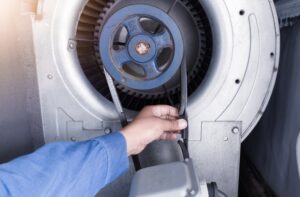
A maintenance technician is getting ready to replace a worn V-belt on an industrial fan. The motor is off, but the fan may still be turning, and automatic controls could restart it. Removing the belt guard will also expose hazardous moving components.
Before work begins, those hazards need to be controlled. Once the equipment is safe to service, there’s another question worth asking: What caused the belt to wear out in the first place?
Good industrial power transmission safety practices address both sides of the job. They protect maintenance personnel from hazardous equipment and help identify mechanical problems before machinery returns to service.
Safety Note: This article explains general safety principles and maintenance practices. It does not replace equipment-specific instructions, required training, an employer’s hazardous-energy control program, or applicable safety regulations. Hazardous maintenance work must be performed by appropriately trained and authorized personnel. If the necessary procedures or safe working methods are missing or unclear, stop and obtain qualified guidance before beginning work.
Why a Stopped Machine Can Still Be Dangerous
Industrial drives have plenty of moving parts. Belts run over pulleys, chains engage sprockets, couplings connect rotating shafts, and gears transfer power through meshing teeth.
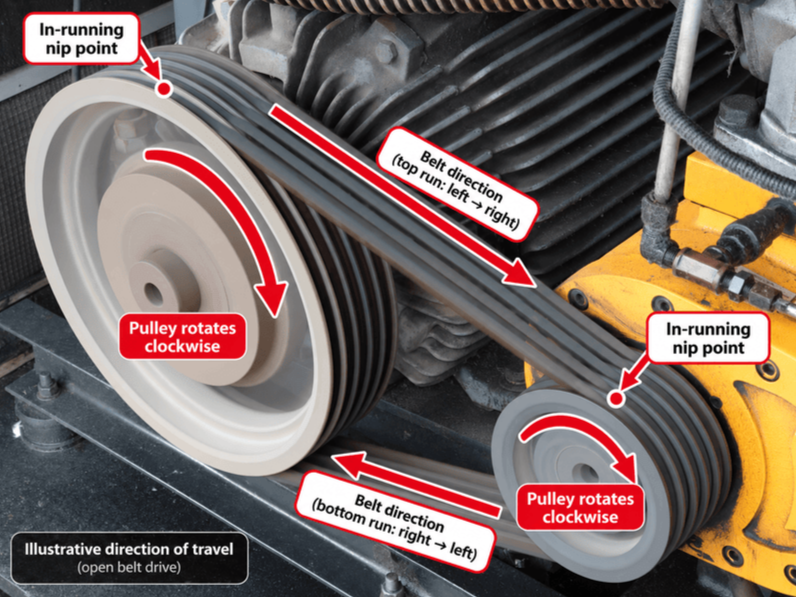
One common hazard is an in-running nip point, where moving components come together. Think of the point where a belt enters a pulley or a chain engages a sprocket. Anything caught there, including clothing, tools, or body parts, can be pulled into the machinery.
Rotating shafts, couplings, exposed keys, and fasteners also create entanglement hazards, even without an obvious pinch point.
Stored Energy: What’s Still Dangerous After Shutdown?
Some hazards remain after you switch off a motor or disconnect it from its power supply.
Stored or residual energy can take several forms:
- Mechanical Tension: A tensioned belt, chain, or spring can release energy when components are loosened.
- Gravity: A suspended load, conveyor counterweight, or raised machine component can move unexpectedly.
- Hydraulic or Pneumatic Pressure: Pressurized fluid or air can cause cylinders and other components to move.
- Rotational Energy: Fans and flywheels may continue turning after their motors stop.
- Electrical Energy: Capacitors and other electrical components can retain hazardous energy after power is disconnected.
These hazards matter most during maintenance because loosening or removing components can release energy that was previously restrained.
Understanding how the parts of a drive interact also helps with troubleshooting. Our guide to how power transmission components work together explains the roles of belts, chains, couplings, bearings, and other components.
What Lockout/Tagout Actually Accomplishes
Lockout/tagout, commonly called LOTO, protects workers from unexpected equipment startup, energization, or the release of hazardous energy during servicing.
The important distinction is that stopping a machine is not the same as isolating it from hazardous energy.
A stop button tells the equipment to stop operating. Energy isolation separates it from hazardous energy sources using appropriate devices, such as an electrical disconnect or certain types of valves.
OSHA’s hazardous energy control requirements establish the basic framework for this process.
An established lockout/tagout process generally includes six stages:
- Prepare and Notify: Identify the equipment, hazardous energy sources, and affected employees. Understand the hazards and how they will be controlled.
- Shut Down: Stop the equipment using its required shutdown sequence.
- Isolate Energy Sources: Operate the appropriate energy-isolating devices. Push buttons and ordinary control switches do not provide physical isolation.
- Apply Lockout or Tagout: Authorized employees secure the energy-isolating devices using the required protective measures.
- Control Stored Energy: Safely release, disconnect, restrain, or otherwise control energy that could cause unexpected movement or injury.
- Verify Isolation: Before servicing begins, the authorized employee verifies that the equipment has been effectively isolated and deenergized.
Lockout physically holds an energy-isolating device in its safe position. Tagout provides a warning but doesn’t offer the same physical restraint. OSHA generally requires lockout where an isolating device can be locked, unless the employer meets the requirements for an equally protective tagout system.
Verification is more than checking that the machine appears to be off. Depending on the equipment, it may involve checking the response to operating controls or using appropriate testing instruments. Electrical testing requires qualified personnel.
The purpose is to establish that the isolation measures actually worked before servicing begins.
Example: Preparing a Belt-Driven Fan for Maintenance
Consider the fan from our opening example.
The technician needs to replace a damaged V-belt. Although the fan has stopped at its control panel, the motor can also be started automatically.
That means the technician needs to identify the correct energy-isolation points rather than relying on the normal stop command.
The fan itself also needs attention. Its rotating components must come to rest, and any mechanical energy that could cause movement when the belt is loosened must be controlled. In some systems, airflow from other equipment can even cause a disconnected fan to turn.
Once the necessary energy controls are in place, the authorized technician verifies that isolation is effective before removing the guard or beginning the repair.
This is why LOTO involves more than switching off a motor and attaching a padlock. The process must account for the actual equipment and everything that could cause it to move.

Don’t Overlook Electrical Hazards During Mechanical Maintenance
A belt or coupling replacement may be a mechanical job, but the drive often includes electric motors, variable-frequency drives (VFDs), and automated controls.
These systems introduce hazards that aren’t always obvious from the mechanical components alone.
For example, VFDs may contain capacitors that retain hazardous electrical energy after the incoming power is disconnected. Automatic controls or multiple power supplies can also complicate energy isolation.
Electrical troubleshooting and testing for the absence of voltage require appropriately qualified personnel and suitable electrical safe-work practices.
Maintenance teams need to recognize when a job involves electrical work beyond their training or authorization so the right people and protective measures are involved.
Machine Guards Protect More Than the Obvious Pinch Points
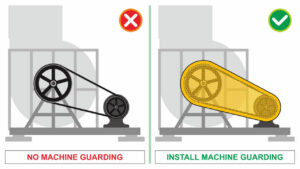
Machine guards help prevent contact with hazardous moving components during normal operation.
They commonly protect workers from belt-and-pulley nip points, chain-and-sprocket engagement, exposed rotating shafts, couplings, and meshing gears.
A guard must also stay secure and in good condition.
Cracked panels, missing fasteners, damaged mounting points, or guards that have shifted out of position can expose hazardous areas. Even a guard that looks intact from a distance may have an opening or clearance problem.
OSHA’s mechanical power transmission guarding requirements cover many of these components. The required guarding arrangement varies with the equipment and applicable requirements.
When maintenance requires removing a guard, appropriate hazardous-energy controls are necessary. Restore guards and protective devices properly before resuming normal operation.
What to Look for During a Power Transmission Equipment Inspection
An inspection should do more than identify obviously broken parts. Wear patterns, unusual movement, noise, and lubrication problems can indicate the condition of the entire drive.
External observations during normal operation may reveal unusual noise, vibration, or leaks. Make these observations from a safe position, without reaching into hazardous areas or bypassing guards.
Hands-on inspections allow closer examination once equipment has been properly isolated and verified safe for servicing.
| Component | Warning Signs | What They Might Indicate |
| V-Belts | Cracks, frayed edges, glazed sidewalls, missing chunks, uneven wear | Slippage, misalignment, heat, incorrect tension, or worn sheaves |
| Sheaves and Pulleys | Worn grooves, cracks, surface damage, uneven wear | Incorrect belt fit, alignment problems, or component wear |
| Roller Chains | Stiff links, corrosion, damaged rollers, excessive wear, elongation | Poor lubrication, contamination, misalignment, or pin and bushing wear |
| Sprockets | Hooked or chipped teeth, uneven wear, visible damage | Chain wear, misalignment, or abnormal loading |
| Couplings | Damaged flexible elements, loose hardware, uneven wear | Misalignment, overloading, installation problems, or vibration |
| Bearings | Abnormal noise or vibration, lubricant leakage, discoloration | Lubrication problems, contamination, excessive loading, or developing damage |
| Gearboxes | Oil leaks, abnormal noise, discoloration, excessive vibration | Seal problems, lubrication issues, misalignment, or internal wear |
These warning signs help narrow down what needs attention. They don’t necessarily identify the exact cause.
For example, shiny, glazed V-belt sidewalls can indicate slipping and heat. But tightening the belt isn’t automatically the solution. Worn sheaves, misalignment, or incorrect belt selection may also be involved.
With roller chains, visible slack alone doesn’t tell the whole story. As pins and bushings wear, the chain elongates, so inspecting the chain and sprockets provides more useful information than simply looking at how loosely the chain hangs.
When Replacing the Worn Part Isn’t Enough
Imagine a belt-driven conveyor that needs another set of V-belts shortly after the previous replacement.
The belts are worn, so replacing them seems straightforward. But why did they wear out so quickly?
A closer inspection might reveal worn sheave grooves, pulley misalignment, or incorrect belt tension. Installing another set without addressing those problems could lead to the same premature wear.
Belt tension also affects neighboring components. Insufficient tension can cause slipping and heat, while excessive tension increases loads on shafts and bearings. This article explains, in more detail, how improper belt tension can damage bearings.
The same principle applies to chains, sprockets, couplings, and other interconnected components.
Not every replacement needs to become a major troubleshooting project. If a part has reached the end of its normal service life, the surrounding components are in good condition, and the existing specification is appropriate, an equivalent replacement is often the practical choice.
Repeated failures, unusual wear, or changing operating conditions are different. That’s when it makes sense to investigate the broader drive and reconsider whether the existing components are still right for the job.
If the original part is obsolete, its specifications are unclear, or the application has changed, Magnum Industrial can help you review replacement options based on your equipment’s requirements.
What Needs to Happen Before Equipment Returns to Service?
Finishing the repair doesn’t automatically mean the machine is ready to restart.
After replacing a component, maintenance personnel must confirm the drive was assembled correctly. This includes checking fastening requirements, alignment, belt or chain tension, and component installation.
Remove tools, loose hardware, and other maintenance materials. Restore guards and protective devices, and position personnel safely before restoring hazardous energy.
Under OSHA’s general industry LOTO standard, the employee who applied each lockout or tagout device normally removes it. A specific exception applies when that employee is unavailable, but only under an established employer procedure with additional safeguards.
Notify affected employees after removing lockout or tagout devices and before starting the equipment.
Once the required checks and authorized restart process are complete, personnel can observe initial operation from a safe position. Investigate unusual noise, vibration, or movement before continuing normal operation.
Power Transmission Maintenance Safety Checklist
This checklist helps technicians and supervisors review key considerations before, during, and after maintenance.
Before Maintenance
- Identify the equipment and hazardous energy sources.
- Establish that qualified and authorized personnel are assigned to the work.
- Identify the required shutdown and energy-control procedures.
- Notify affected employees, isolate energy sources, and apply required lockout or tagout protection.
- Control stored energy and verify isolation before servicing begins.
During Inspection and Repair
- Inspect relevant drive components for damage, wear, or abnormal conditions.
- Examine related components and investigate recurring failures.
- Check replacement parts against the equipment’s requirements.
- Complete the required installation, alignment, tensioning, and fastening checks.
- Document defects, repairs, and additional work needed.
Before Returning to Service
- Verify that repairs are complete and remove tools or loose materials.
- Restore guards and protective devices.
- Account for personnel and ensure they’re safely positioned.
- Complete authorized lock-removal, notification, and restart procedures.
- Observe initial operation safely and investigate abnormal conditions.
Find the Right Replacement Parts With Magnum Industrial
A successful repair depends on choosing components that match the equipment, not just finding something that looks like the original part.
Sometimes the existing part number is all that’s needed. Other times, a component is obsolete, the equipment has changed, or repeated failures suggest that the original specification deserves another look.
When contacting Magnum about replacement parts, it helps to have:
- Part Information: Manufacturer, part number, and markings from the original component.
- Equipment Details: Machine make, model, and the component’s position within the drive.
- Dimensions: Shaft diameter, bore, mounting arrangement, or other relevant measurements.
- Operating Conditions: Speed, load, temperature, contamination, or other application factors.
- Maintenance History: Recurring failures, unusual wear, and any problems found during inspection.
- Photographs: Clear images of the component, its markings, and visible damage.
You don’t need every answer before reaching out. Even a worn part, a few measurements, and a description of the problem can provide a useful starting point.
Magnum Industrial supplies bearings, belts, sheaves, chains, sprockets, motors, and other industrial power transmission components. Our team can help you identify replacement options, locate hard-to-find parts, and work through product questions when the right choice isn’t obvious.
Whether you’re replacing a single worn component or evaluating alternatives for a troublesome application, contact Magnum Industrial to discuss what your equipment needs.